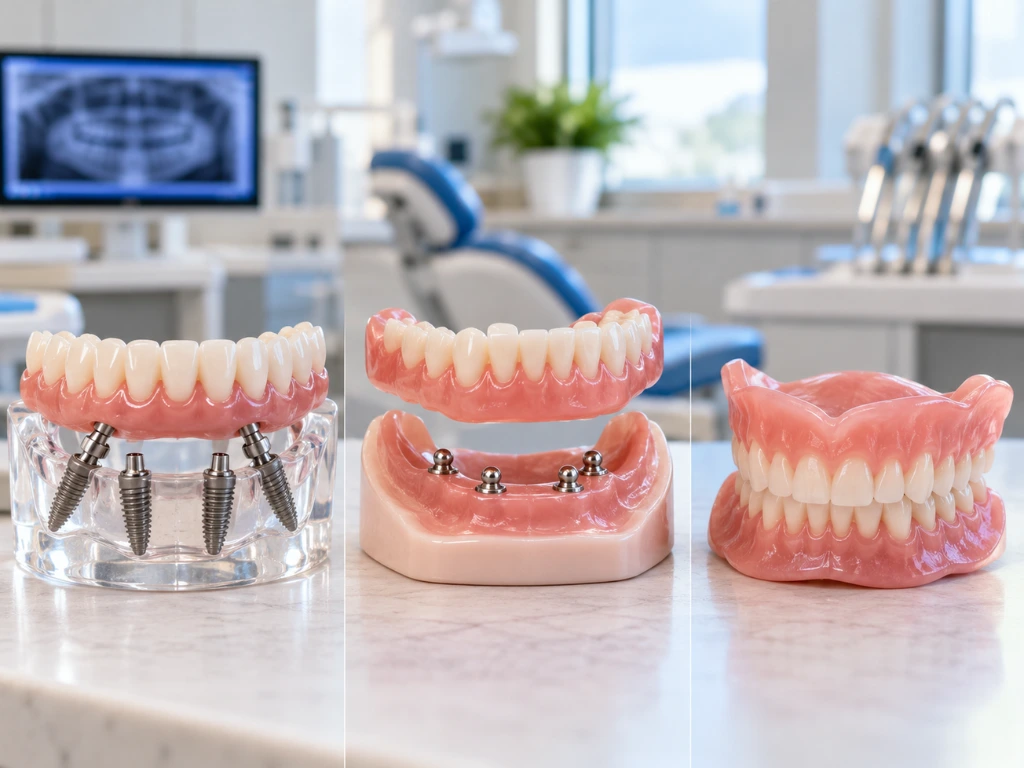

If your lower denture slides around and your jawbone is too narrow for standard implants, mini dental implants can hold it steady. In most cases you’ll need four minis where two standard posts would do. Each mini costs less, but a full arch costs about the same, and in trials minis fail more often than standard implants.
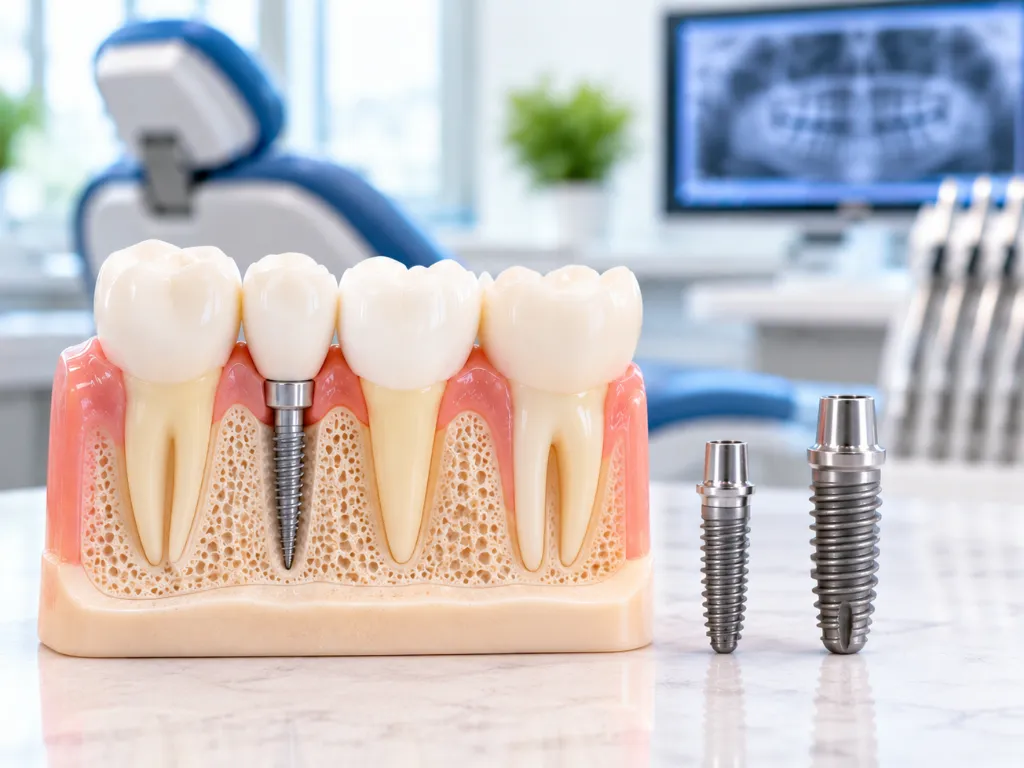
Mini implants are one-piece titanium posts under 3 mm wide, about half the width of a standard implant. Your dentist places them through the gum to anchor a loose lower denture or a small front tooth where the bone is too thin for a standard implant. In March 2026, California in-network rates averaged $869 per mini implant. If you wear dentures in Vista or North County and you’re weighing the two, this guide sets out the trade-offs. Our practice offers implant and family dentistry in Vista.
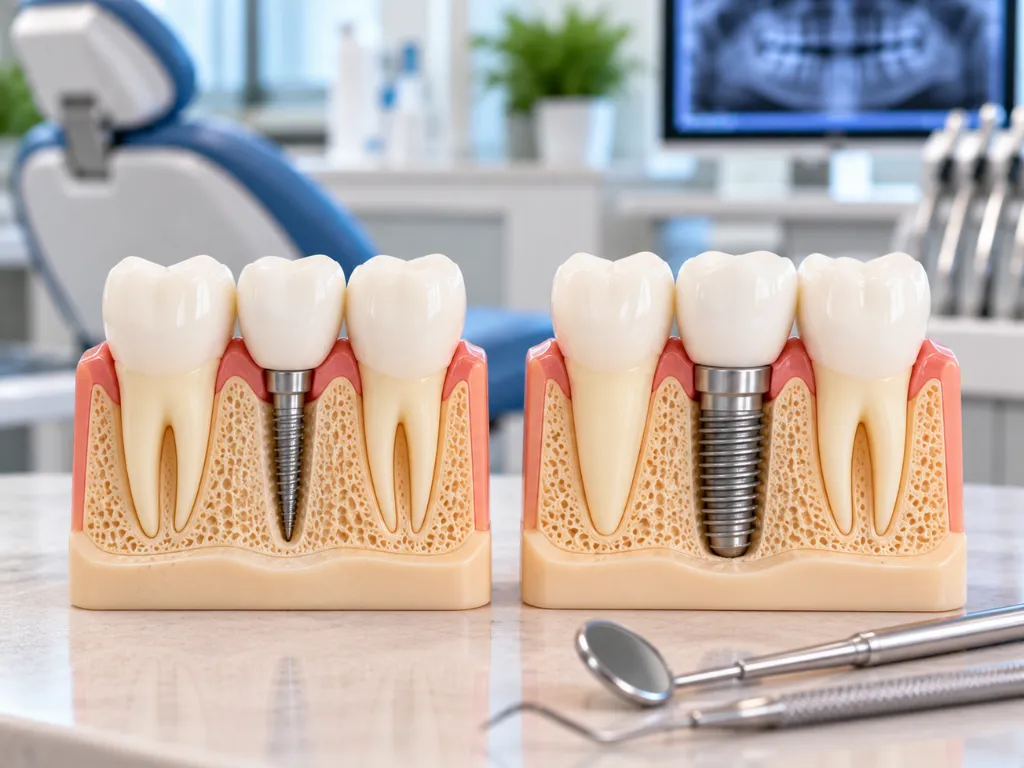
A 2022 overview in Dental Update defines a mini dental implant as one less than 3 mm in diameter, typically between 1.8 mm and 3 mm. A standard implant is roughly twice as wide: the 2015 Journal of Dental Research trial compared 2 mm minis with 4 mm standard implants. Narrow-diameter implants of 3.3 to 3.5 mm sit between the two.
Most mini implants come as a single piece, with the post and attachment head joined and no separate abutment. That makes placement simpler. The catch comes when two implants point in different directions, because your dentist can’t angle the head afterwards.
Dentists tend to place minis flapless: they drill a narrow pilot hole straight through the gum instead of cutting and lifting a flap. In a 12-year practice review of 5,640 mini implants, the pilot drill was 1.2 mm wide. Your dentist can often attach the denture the same day, a step called immediate loading.
Definitions vary, so ask for the number. The International Team for Implantology (ITI) consensus review by Schiegnitz and Al-Nawas (2018) groups implants under 3.0 mm as Category 1, and its discussion narrows one-piece minis to under 2.5 mm. If a quote says “mini”, it should state the diameter in millimeters.
Minis come out ahead on bone width, surgery and price per post. Standard implants come out ahead on strength, survival and the range of teeth they can replace.
Mini implant
Standard implant
The survival gap shows up across studies. In the ITI narrow-diameter implant review, implants under 3 mm averaged 94.7% survival and carried 4.54 times the odds of failure of standard implants. Implants of 3.3 to 3.5 mm averaged 97.7%, with no significant difference from standard implants.
In most cases, the width of your ridge decides. Klein and colleagues (2014) note that most authors want at least 1 mm of bone around an implant, which “requires a horizontal crestal alveolar width of 6 mm for a standard implant.” If your ridge is that wide, our standard dental implants in Vista are the default choice.
Minis make their strongest case on a narrow lower jaw with a loose denture. Four minis clip the denture in place without the bone graft a standard implant would need.
This use also has the most evidence behind it. A 2019 systematic review by Jawad and Clarke in the International Journal of Oral and Maxillofacial Implants pooled 17 studies covering 1,715 mini implants in 475 patients, most with four implants per jaw. Survival was 95.6% over an average of 28 months.
Patients like the result. In a randomized trial of 120 denture wearers (de Souza et al., 2015), lower dentures on two or four minis gave better oral health quality of life than dentures on two standard implants, and the four-mini group reported higher satisfaction. Survival told a different story: at 12 months, 89% for four minis, 82% for two minis and 99% for standard implants.
The ITI reviewers stayed cautious. Schiegnitz and Al-Nawas (2018) called overdentures on at least four or six minis “a promising alternative treatment when insertion of SDI due to extreme bone atrophy is not possible”, where SDI means standard-diameter implants. A 2017 review by Park, Lee and Shin found 0.28 to 1.2 mm of bone loss around minis after the first year.
Mini implants suit you if:
At Main Street Dental, Dr. Dan Javaheri checks whether your jaw suits minis or standard implants before recommending one of our snap-in denture options. Our guide to how implants compare with dentures explains why a denture held by implants keeps more bone than one resting on your gums.
Choose standard implants for back teeth, fixed bridges, most upper jaws, and if you grind your teeth. A thinner post carries more stress and breaks more easily.
The ITI review draws a clear line. Klein, Schiegnitz and Al-Nawas (2014) wrote: “Mini-implants < 3.0 mm in diameter are only documented for the edentulous arch and single-tooth non-load-bearing regions.” They added that a narrow implant “is also more prone to fatigue fracture as a result of a reduced implant diameter.”
Bone density matters as much as width. Your upper jaw has softer bone, and in the 12-year practice review, minis survived at 91.3% in the upper jaw against 93.1% in the lower. Prosthodontist Gordon Christensen, DDS, advises at least 30 Ncm of torque when your dentist screws a mini in, a sign the bone has a good grip on it.
The 2022 Dental Update overview rules minis out in these situations:
Minis also lack long-term data. Only 4 of 16 studies in the 2017 Park review followed patients beyond three years. Standard implants have decades of follow-up, which our guide to how long standard implants last covers.
If your ridge can take a standard implant, or a small graft would make it possible, choose standard implants. Save minis for a ridge that’s too narrow for anything else.
In March 2026, insurer-negotiated rates for a mini implant in California averaged $869, about half the $1,779 average for a standard implant post. A lower denture needs twice as many minis, though.
Posts-only averages in California for one lower arch, 2026:
These figures come from PayorMap’s California D6013 rate data, compiled from insurers’ federal Transparency in Coverage files. The middle half of 77 mini implant rates ran from $747 to $990, and the full range from $421 to $1,393. Read them as a minimum, since each office sets its own fee above these rates. Offices bill attachments, denture work, scans and any extractions on top.
Price a mini implant plan per arch. Four minis and two standard posts land within $82 of each other, so base the decision on your bone and leave the per-implant price out of it.
Main Street Dental accepts most PPO plans and offers Cherry payment plans to spread the cost. Ask your PPO whether it covers code D6013 as well as D6010.
Minis fix one problem well: a loose lower denture on a jaw too narrow for standard implants. Four minis cost about the same as two standard posts, go in without a gum flap and can often hold your denture the same day. On the downside, they fail and fracture more often, and their long-term record is short. If your bone allows a standard implant, that’s the stronger choice. If it doesn’t, minis give you a way to skip the bone graft.
Book a mini implant consultation at Main Street Dental, 1830 Hacienda Dr, Suite 1, Vista, CA 92081, through our contact page, or call (760) 295-9870.
Minis show good short- to medium-term results, but there’s little long-term data. A 2019 review of 1,715 mini implants holding lower dentures found 95.6% survival over an average of 28 months. Only 4 of 16 studies in a 2017 review followed patients beyond three years, so standard implants have the longer record.
In many cases, yes. Many dentists attach the denture on the day they place the minis, a step called immediate loading, as long as the implants grip the bone well. Prosthodontist Gordon Christensen advises at least 30 Ncm of insertion torque. If your bone is soft, your dentist will wait for healing before loading the implants.
Yes, if it’s a small front tooth that takes little biting force, such as a lower front incisor. The ITI reviews document implants under 3 mm only for full-arch dentures and single non-load-bearing teeth. Premolars and molars need a standard implant to handle chewing force, and so does a bridge.
At Main Street Dental, 1830 Hacienda Dr, Suite 1, Vista, CA 92081, we assess patients for both mini and standard implants. Dr. Dan Javaheri, DDS, a New York University College of Dentistry graduate, leads the practice. We accept most PPO plans and offer Cherry payment plans. Call (760) 295-9870 to book an exam.